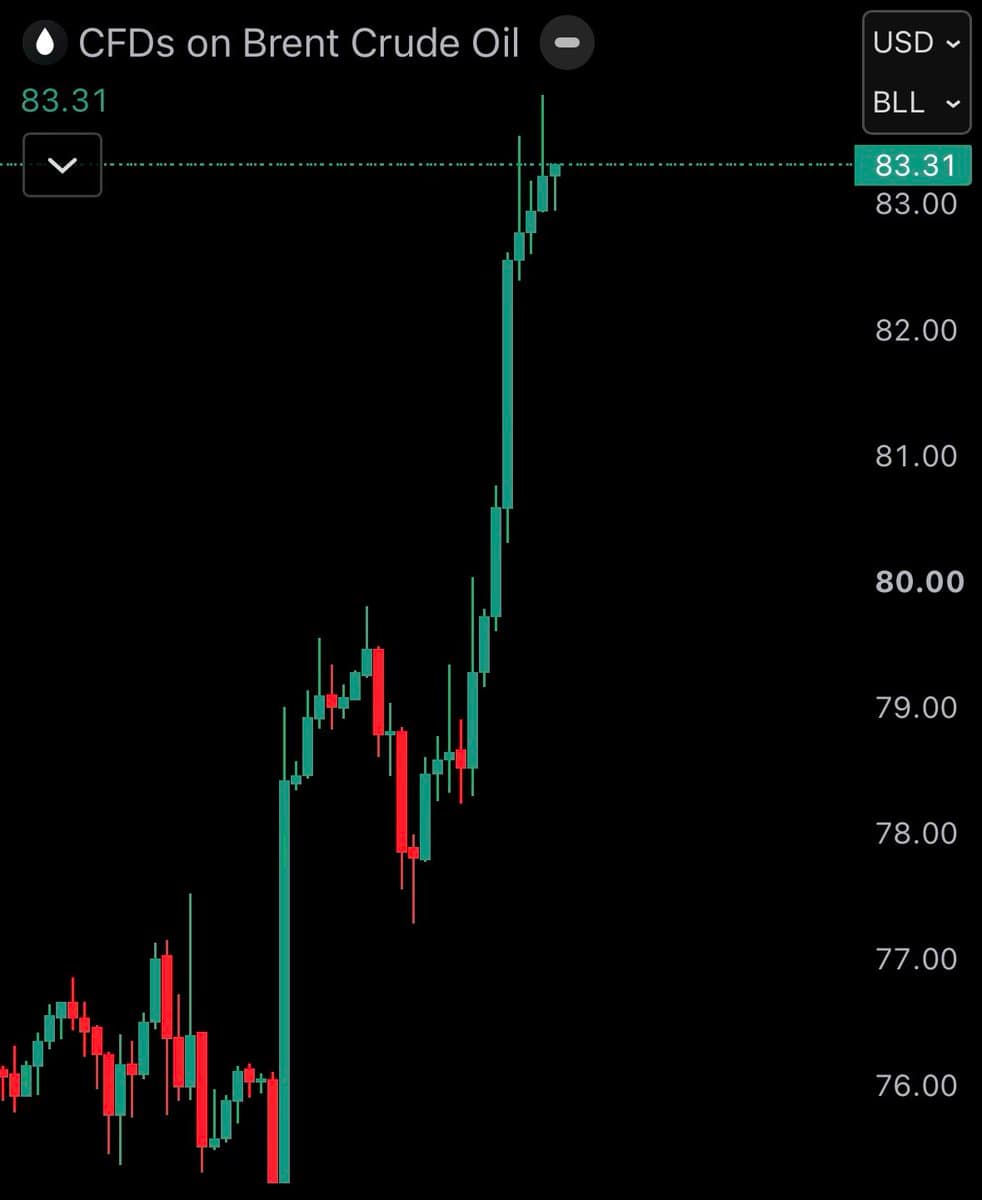
Geopolitical Premium Drives Oil Higher
Crude oil markets posted a decisive rally as renewed US-Iran tensions sent risk assets and defensive commodities into sharply divergent trajectories. Brent crude jumped 10% according to market sources tracking the move, signaling that traders are reassessing supply-chain disruption risk in one of the world's most critical energy corridors. The move reflects the classic geopolitical risk premium: when regional conflict escalates, oil buyers price in the potential for production outages or shipping delays through the Strait of Hormuz, which handles roughly 20% of global seaborne crude exports.
WTI, the primary US crude benchmark, moved in tandem with Brent, though relative performance between the two grades depends on specific refinery demand dynamics and storage levels. The 10% rally in Brent represents a material directional shift - not typical daily noise but a structural repricing of tail risk in energy markets.
Why This Matters for Traders
Oil volatility clusters around geopolitical shocks because supply is inelastic in the short term. Unlike equities or crypto, where traders can hedge with derivatives or rotate into cash, crude production takes months to ramp or curtail. When conflict risk spikes, the forward curve can invert (contango flip to backwardation) as traders demand immediate supply at a premium over future barrels.
For position traders, the key structural question is duration: does this tension resolve in days (price reversal risk) or escalate into sustained sanctions or operational losses (sustained premium)? Historical precedent matters here. The 2011 Libya conflict and 2019 Saudi Aramco drone strikes both produced sharp 10-15% rallies, but only the former led to multi-month supply disruptions. The 2022 Russia-Ukraine war, by contrast, created a sustained 40+ dollar/barrel floor as traders feared long-term supply loss.
Volume patterns and implied volatility in crude futures and options should be monitored closely. High notional open interest in out-of-the-money call spreads suggests institutional hedgers are bracing for further upside; conversely, if volume fails to follow the price move, it may signal retail exhaustion rather than structural buying.
Macro Cross-Currents
Read the full analysis.
Enter your email to unlock this article — and get every new Brief delivered the moment it publishes. Free. No spam.
No spam. Unsubscribe anytime. The desk's read, free.
The Feed behind this read. $25.
Join The FeedThe Feed $25. Telegram alerts + desk feed.
Live data behind this story: the real-time crypto terminal →