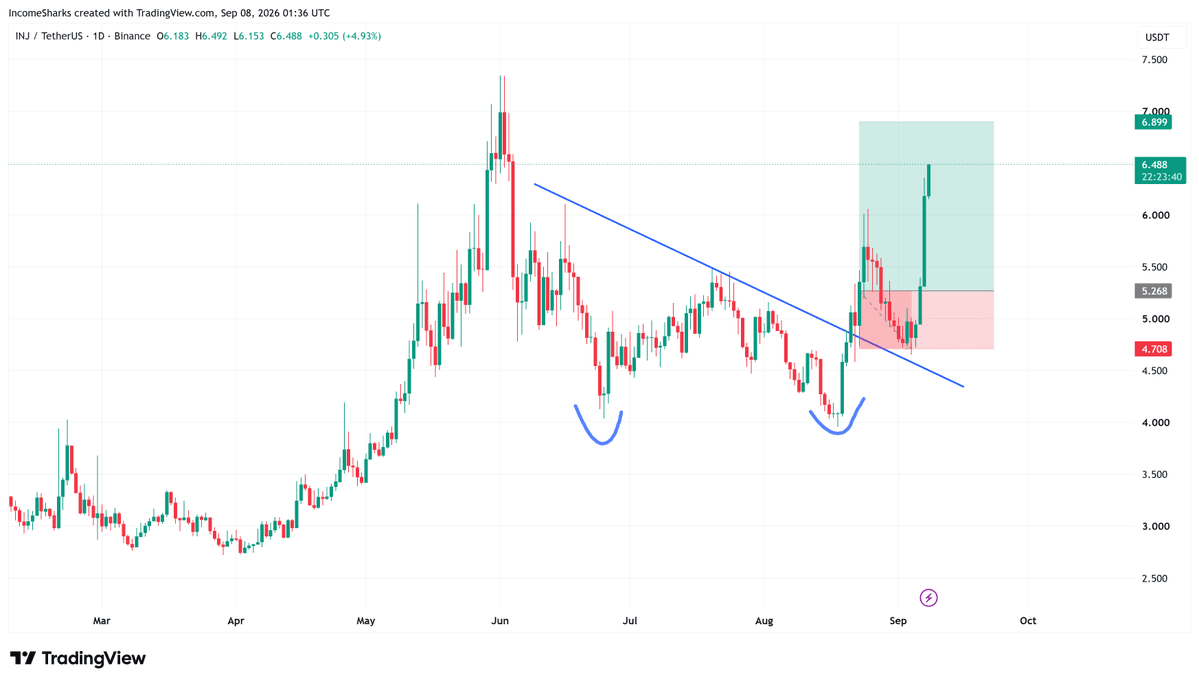
The Injective Narrative Shift
$INJ has emerged as the session's outlier among the three major macro narratives. While $BTC languishes at $79,340 (down 0.72% in 24h) and $ETH trades flat at $2,500.02 (down 0.11%), Injective's Galaxy Score has climbed to 93/100 with AltRank 3 and 88% positive sentiment. This is not retail euphoria - it's a measurable reordering of institutional and semi-pro positioning in the protocol space. The 0.24% social dominance suggests capital is flowing selectively into $INJ rather than broad-market altcoin revival.
Traders responding to this momentum typically cite two catalysts: on-chain incentive restructuring and yield competitiveness across derivative venues. Injective's native perpetual and spot trading infrastructure has historically attracted capital during periods when CEX funding rates compress or when cross-margin opportunities favor protocol-level settlement.
TVL and Incentive Mechanics
The timing of Injective's social dominance spike coincides with protocol rebalancing cycles, when governance and token emissions shift to defend TVL against competing Layer 1 and specialized derivative platforms. Unlike Solana or Base, which derive TVL primarily from lending and DEX liquidity, Injective's capital retention depends on sustained incentives to traders using its native perps - a higher carrying cost but also higher velocity of capital.
During periods when $BTC and $ETH trade range-bound with low realized volatility (as seen in the current 24h print), traders rotate toward venues offering tighter margins or lower friction on leverage. Protocol governance tokens like $INJ often outperform broad indices when this rotation occurs, because incentive budgets are deployed to defend market share rather than reward stakers with passive yield.
The current session's context - $BTC stable, $ETH stable, social dominance heavily skewed to $BTC (24.40%) and $ETH (9.51%) - creates an environment where smaller, focused ecosystems can capture traders' attention precisely because they are not moving in lockstep with macro prints. $INJ's 93 Galaxy Score reflects this differentiation.
Positioning and Stop-Loss Mechanics
Anecdotal reports from active traders describe the tactical hazard of stop-loss placement in small-cap protocol tokens. When $INJ rallies sharply after traders are stopped out, it signals one of two conditions: either accumulated stop-loss orders above a key level triggered a cascade that flushed weak holders, or institutional buyers entered at stops. In either case, the mechanics are clean - price moves, liquidation engines clear, and then momentum buyers step in.
This pattern is most pronounced in venues with lower absolute liquidity but higher per-dollar incentives to traders. Injective's native exchange model, combined with protocol-level rebates, means that stop-losses can trigger more violently than on larger order books, but recoveries can also be sharper when buyer intent re-enters. The current AltRank 3 positioning suggests algorithmic and semi-pro traders have rotated long, meaning stops are likely placed below recent swing lows - typically 2-5% below the breakout level depending on volatility regime.
For context, this session's low realized volatility in $BTC and $ETH ($22.8B and $11.2B in 24h volume respectively, both well below 30-day averages) creates a technical environment where $INJ's isolated movement and higher volatility appear amplified. Traders accustomed to tight ranges in the largest assets may overweight smaller protocol moves as "breakout" signals.
Key Takeaways
- $INJ's Galaxy Score 93 and 88% positive sentiment reflect selective capital rotation into protocol yield and derivative venue incentives, not broad market rally.
- Injective's TVL defense relies on ongoing token emissions and tighter trading friction - a strategy that works in range-bound macro conditions like today's $BTC/$ETH stability.
- Stop-loss mechanics in lower-liquidity protocol tokens can trigger flush moves followed by sharp recoveries, but this does not predict directional conviction or macro positioning.
- $BTC and $ETH remain the macro anchors at $79,340 and $2,500.02 respectively, constraining the risk-on narrative that would sustain $INJ momentum beyond the current session.
- Traders managing exposure to $INJ should monitor TVL withdrawals and incentive budget depletion, not social sentiment, as leading indicators of directional reversal.